I've spent twenty plus years watching platform shifts turn into services businesses. The internet wave did it. Cloud and big data did it. Both times, the pattern was the same: the technology arrived first, and then someone had to actually make it work inside real enterprises, with real data, real governance, and real people who had to be trained to run it.
We built Dynagentic on the bet that agentic AI would follow the exact same pattern, and that the winners would be the teams who showed up to do the unglamorous work of building, training, and supporting the deployment, not just the teams who shipped the smartest model.
I didn't expect the market to confirm that bet quite this fast, or this loudly.
Market Validation
Sixty Days, $6.5 Billion
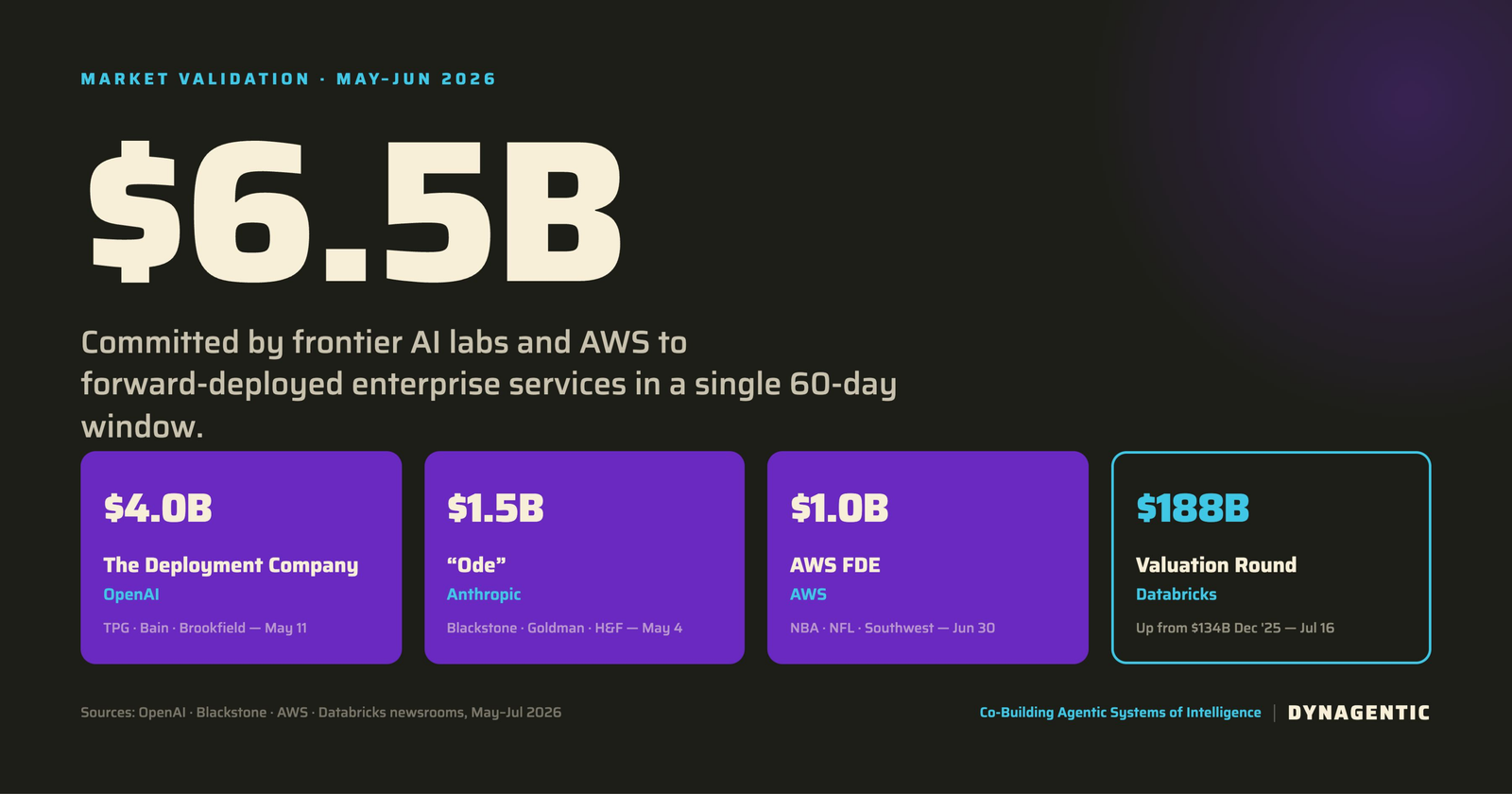
Between May and July of this year, the frontier AI labs and AWS put more than $6.5 billion behind forward deployed enterprise services. Not model training. Not consumer products. Services. The work of embedding engineers inside enterprises to build, train, and run agentic systems.
Look at what happened in that window.
- $4.0 billion went into The Deployment Company, a standalone venture built with OpenAI, backed by TPG, Bain Capital, and Brookfield. It acquired a 150-engineer forward deployed engineering firm on day one.
- $1.5 billion funded Ode, a joint venture with Anthropic backed by Blackstone, Goldman Sachs, and Hellman & Friedman, to embed engineers directly inside mid-size businesses and PE portfolio companies.
- $1.0 billion went to AWS FDE, AWS's self-funded, internal forward deployed engineering org, already working with customers like the NBA, the NFL, and Southwest, built without private equity money behind it.
- Databricks' valuation jumped to $188 billion in a strategic round, up from $134 billion in December and $62 billion the December before that, on the back of $4.1 billion plus in ARR and positive cash flow.
Four different players, four different structures, one identical conclusion: models alone don't change how an enterprise operates.
Someone has to build the orchestration, train the people who'll run it, and support the system once it's live. That is the exact four discipline lane, Think Big Strategy, Train, Build, Support, that Dynagentic was built around before any of this hit the newswire.
Market Size
The Category Is Bigger Than the Moment
It's tempting to read $6.5 billion in 60 days as a fluke of momentum. It isn't. It's a data point inside a category that was already growing fast.
The global AI consulting and enterprise services market is on track to grow from roughly $9.6 billion to $74 billion between 2025 and 2034, a 25.6% compound annual growth rate. Widen the lens to include the Big Four and global systems integrators building out their own AI practices, and the broader AI consulting and support category still reaches $74 billion globally by 2030, growing north of 31% a year.
North America alone is projected to grow from about $3.0 billion to $28 billion by the mid-2030s, roughly 37% of the global market today. That makes North America the largest, most mature regional market for AI consulting anywhere, and the natural beachhead for a services company built the way we built Dynagentic: forward deployed, AI-native, and unafraid of the mid-market accounts the biggest players don't have time for.
$6.5 billion committed in two months isn't the whole story.
It's the leading edge of a category that was already going to be worth tens of billions by the end of the decade. The frontier labs and AWS just told everyone, at the same time, exactly how confident they are in that number.
Infrastructure
Infrastructure Spending Confirms It From the Other Direction
If the services capital tells you where enterprises are headed, the infrastructure numbers tell you how big the wave underneath it really is.
Nvidia closed its fiscal 2026 with $193.7 billion in data-center revenue, up 68% year over year. On the earnings call, Jensen Huang put it plainly.
"Computing demand is growing exponentially, the agentic AI inflection point has arrived. Enterprise adoption of agents is skyrocketing."
Jensen Huang, Nvidia
He's now projecting a $3 to $4 trillion AI infrastructure opportunity over the next five years.
Here's the part that matters for a services company: every dollar of that infrastructure spend creates a downstream requirement that no chip, no model, and no cloud contract can fulfill on its own.
Someone has to sit between the infrastructure and the enterprise and actually build the agentic workflows, govern them, and keep them running. That's the deployment and adoption layer, and it's where Dynagentic lives.
Look at who's occupying that layer today, and the gap is obvious. The frontier labs run high-touch forward deployed engineering programs, but they're reserved for their largest enterprise logos. AWS is building cloud-native deployment capability, but it's tied to AWS infrastructure commitments. The Big Four and global systems integrators bring scale and trust, but they're slow moving, and AI-native was never how they were built. That leaves a real, sizable gap between frontier-lab exclusivity and legacy-SI inertia, and it's exactly the enterprise and mid-market space Dynagentic was built to serve.
Our Thesis
The Agentic Gap Was Never a Hypothesis
We call this the Agentic Gap: the chasm between enterprises running promising AI pilots and enterprises running a fully operational, governed, agentic system that actually compounds in value. Most companies aren't stalled because the models aren't good enough. They're stalled because their people aren't trained to operate what they've deployed, their approach has no repeatable structure, and their systems have no governance built in from the start.
That gap is why Think Big Strategy, Train, Build, and Support operate as a closed loop at Dynagentic rather than four separate line items you can buy piecemeal. It's why Build runs on our 6D Framework, Define, Design, Develop, Diagnose, Deploy, Direct, instead of ad hoc sprints. And it's why we talk about an Agentic System of Intelligence rather than a delivered project: the whole point is that clients own a capability that keeps compounding long after we've moved to the next phase.
What changed this summer isn't our thesis. It's the size of the check the market is now willing to write to prove the thesis right. When four separate players, backed by some of the most sophisticated capital in the world, converge on the same structural bet in the same 60-day window, that's not noise. That's timing.
We built Dynagentic to be in position for exactly this moment: AI-native from day one, forward deployed by design, and built to serve the enterprise and mid-market accounts that the frontier labs don't have bandwidth for and the legacy SIs don't have the muscle to serve well.
The market didn't just validate that decision. It put a number on it: $6.5 billion, in 60 days, and counting.
If you're trying to figure out where your organization sits relative to this shift, or what it takes to close the Agentic Gap before it closes on you, I'd like to hear what you're seeing.
Start a Conversation